U.S. Senate See Full Big Line

(D) J. Hickenlooper*

(R) Janak Joshi

80%

20%

(D) Michael Bennet

(D) Phil Weiser
55%

50%↑
Att. General See Full Big Line

(D) Jena Griswold

(D) M. Dougherty

(D) Hetal Doshi

50%

40%↓

30%

Sec. of State See Full Big Line
(D) J. Danielson

(D) A. Gonzalez
50%↑

20%↓
State Treasurer See Full Big Line

(D) Jeff Bridges

(D) Brianna Titone

(R) Kevin Grantham

50%↑

40%↓

30%

CO-01 (Denver) See Full Big Line

(D) Diana DeGette*

(D) Wanda James

(D) Milat Kiros

80%

20%

10%↓

CO-02 (Boulder-ish) See Full Big Line

(D) Joe Neguse*

(R) Somebody

90%

2%

CO-03 (West & Southern CO) See Full Big Line

(R) Jeff Hurd*

(D) Alex Kelloff

(R) H. Scheppelman

60%↓

40%↓

30%↑

CO-04 (Northeast-ish Colorado) See Full Big Line

(R) Lauren Boebert*

(D) E. Laubacher

(D) Trisha Calvarese

90%

30%↑

20%

CO-05 (Colorado Springs) See Full Big Line

(R) Jeff Crank*

(D) Jessica Killin

60%↓

40%↑

CO-06 (Aurora) See Full Big Line

(D) Jason Crow*

(R) Somebody

90%

2%

CO-07 (Jefferson County) See Full Big Line

(D) B. Pettersen*

(R) Somebody

90%

2%

CO-08 (Northern Colo.) See Full Big Line

(R) Gabe Evans*

(D) Shannon Bird

(D) Manny Rutinel

45%↓

30%

30%

State Senate Majority See Full Big Line

DEMOCRATS

REPUBLICANS

80%

20%

State House Majority See Full Big Line

DEMOCRATS

REPUBLICANS

95%

5%

Generic selectors
Exact matches only
Search in title
Search in content
Post Type Selectors
April 18, 2016 06:42 PM UTC

Q1 Fundraising Winners and Losers

  •  
  • by: Colorado Pols

We have a long tradition at Colorado Pols of examining “Winners and Losers” from key fundraising periods, and the Q1 reports that were due on April 15th represent probably the most important three-month period since Colorado moved its Primary election to June prior to the 2014 election cycle.

The first (and last) full quarterly fundraising cycle before the June 28th Primary ended at midnight on March 31, but federal campaigns weren’t required to submit their complete Q1 reports until April 15th. Campaigns for the U.S. House are required to file fundraising reports electronically, but Senate campaigns can drag out the public disclosure period for days (and sometimes weeks) by filing their fundraising numbers (literally) on paper and mailing the reports to the Federal Elections Commission (FEC).

We’ve been anxious to compare fundraising numbers for Q1, particularly from the 5 remaining Republican Senate candidates; for most of the GOP Senate field, the Q1 numbers are about the only objective information we have to go on right now in terms of evaluating a campaign’s strengths and weaknesses. We’ll update this post in a few days (or weeks) as new information becomes available, but with most campaigns announcing their fundraising hauls late Friday or over the weekend, we can still sketch out a pretty good list of “Winners and Losers” already.

For this “Winners and Losers” list, we are only comparing fundraising numbers for the U.S. Senate race and CD-6. In most Congressional districts in Colorado, the full slate of candidates wasn’t even known until Democrats concluded their caucus process with Saturday’s State Convention in Louisville.

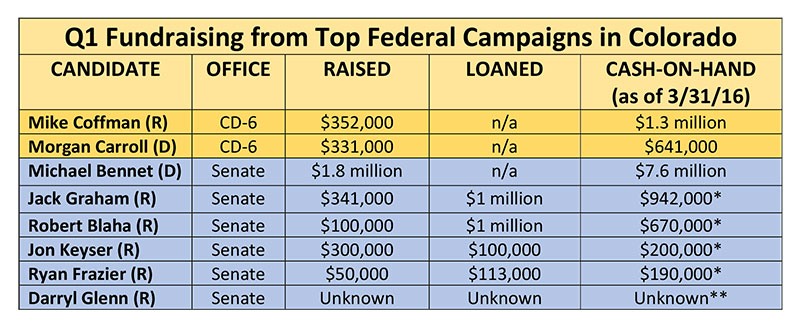
Q1Fundraising-2016-Chart

NOTES:
*Cash-on-hand totals for Graham, Blaha, Keyser, and Frazier may not account for any outstanding balance owed to petition signature-gathering firms…or for most staffing expenses, for that matter. Campaigns typically hold off on making significant expenditures until the day after the end of the fundraising period so that they can “report” a larger cash-on-hand amount.

**We don’t yet know how much money Glenn has in the bank, but we do know that he doesn’t have any six-figure balances owed to petition-gathering firms. Because Glenn made the Primary ballot through the caucus/convention process, his expenditures will naturally be significantly less than his opponents.

Click after the jump for our “Winners and Losers” of Q1…


“Q1 WINNERS”

Mike Coffman and Morgan Carroll
The race in CD-6 is once again one of the Top 10 House battles to watch in 2016, and before November we would expect the bulk of the money spent in Colorado to come from outside sources (soft money groups, SuperPACs, etc). Both Congressman Mike Coffman (R) and his challenger, state Sen. Morgan Carroll (D), performed well in the first quarter of 2016 and produced about as well as could have been expected. By most accounts Q1 was a difficult time to raise money as a federal candidate, what with so much money and attention being diverted to the various Presidential candidates. In that environment, a quarterly haul in the mid-300s is a pretty solid three months of work. More importantly, both Coffman and Carroll met general expectations for their respective campaigns.


Michael Bennet
While he watches the Republican field of Senate candidates get whittled down (there were 13 GOP candidates in March, and 5 campaigns are still functioning as of this writing), Bennet continues to methodically build up an impressive warchest. It’s probably safe to assume that Darryl Glenn didn’t corral a particularly impressive fundraising haul from Q1 — his campaign has kept quiet about their fundraising thus far — which means that Bennet raised twice as much money as the entire GOP field combined.

That previous comparison was only about money collected from donors. If we include candidate loans and compare cash-on-hand amounts, we find that Bennet has almost 4 times as much money in the bank as the entire Republican field of Senate candidates. That’s a staggering difference, and the eventual GOP nominee is going to find it nearly impossible to close that gap before General Election mail ballots start dropping in mid-October.

As if that weren’t enough on its own, the Democratic Senatorial Campaign Committee (DSCC) let it be known late last week that it had already reserved $2.3 $4.8 million for statewide television ads in Colorado beginning on October 11th.


Jack Graham
We already knew that Graham had deposited a cool million into his own campaign account – it was part of Graham’s pitch when he announced his candidacy earlier this year – but Graham also collected more campaign donations than his Republican opponents. With $341,000 collected in Q1, Graham is the only GOP Senate candidate to end up in the same fundraising ballpark as Coffman and Carroll. Graham also has a sizable lead over his GOP counterparts when it comes to cash-on-hand; with $942,000 in the bank, Graham has access to more funds than the rest of the Republican field put together.


Robert Blaha
It is not particularly unusual to find a self-funding millionaire in a high-profile Primary battle, but two of them? That’s what we’ve got with the Republican field in 2016. Blaha did not impress in the “collecting checks” department, with only about $100,000 raised from donors, but fundraising was never going to be a focus for Blaha; even when Blaha was just “testing the waters” of a potential Senate run last fall, he always made it clear that he planned on self-funding to a significant degree. Mail ballots will begin to deploy to Primary voters in about eight weeks, so it’s not that important to dwell on where Blaha’s money comes from – only that it exists.


“Q1 LOSERS”


Jon Keyser
It’s quite possible, and perhaps even probable, that Keyser’s campaign was functionally broke at the end of March.
Keyser’s campaign reportedly raised $300,000 in Q1, and coupled with a $100,000 loan from the candidate himself, supposedly Keyser has about $200,000 cash-on-hand as of April 1. However…we know that Keyser has several staffers on his campaign already (including big-name fundraisers such as Monica Owens), and signature-gathering firms alone probably cost him in the neighborhood of $200k, so the only way this math works out is if Keyser didn’t pay most of his bills until after the Q1 period had closed on March 31. As we mentioned earlier, it is a pretty common tactic for a campaign to hold off on making big expenditures in order to show a larger amount of cash-on-hand; Keyser may have had $200k in the bank at the end of March, but he almost certainly spent most of that “warchest” a day or two later. We’ll know for sure the extent of the damage to Keyser’s campaign when Q1 reports are publicly-available in a couple of days, but it certainly doesn’t look good for him right now. You don’t make a $100k loan to your campaign if all is well.

Even if Keyser hasn’t virtually emptied his campaign account, his fundraising haul of $300k is an absolutely disastrous number for a candidate whose only real metric for success was to show that he could bring in big bucks as the NRSC’s “top recruit.” When Keyser’s name was picking up steam as a potential candidate in December, there were lots of unnamed sources quoted in media outlets saying that Keyser already had “$3 million” worth of soft-money promises. Perhaps those promises are still on the table, but normally candidates have to show their own ability to raise money independently before those promises can be fulfilled.

When we wrote our Q1 fundraising preview on March 30, we said that anything less than a $1 million quarter from Keyser would indicate serious problems in his campaign. Even if you disagree with the specific number in that assessment, there’s no sugarcoating the fact that Keyser is running for the U.S. Senate – a statewide race — and he was outraised by a Democratic challenger running for a U.S. House seat (Morgan Carroll).


Ryan Frazier
Frazier’s campaign says it raised only about $50k, and combined with a $113k personal loan, his cash-on-hand figure is supposedly around $190k. But Frazier is in a similar situation as Keyser in that he has some significant expenditures that would seem to have been pushed back so as not to show up on his Q1 report. Frazier has a big bill to pay for petition-gathering, so his $190k cash-on-hand as of March 31 is probably much closer to zero today.


Darryl Glenn
Without knowing how much he raised, we have to count Glenn among the fundraising “Losers” in Q1 on the assumption that his campaign would not have remained mum on his finances if Glenn had produced a strong quarter. Unlike his four Republican opponents, however, Glenn (probably) doesn’t have hundreds of thousands of dollars in expenditures that he owes to outside consultants – a huge benefit to making the Primary ballot through the relatively-inexpensive caucus process. Glenn probably did not have a strong Q1 fundraising quarter, but he should have been able to raise a fair amount of money after his surprise victory at the April 9 GOP State Convention; winning candidates at the State Convention typically receive a bounce in campaign donations from the Party faithful.


Comments

Recent Comments


Posts about

Donald Trump
SEE MORE

Posts about

Rep. Lauren Boebert
SEE MORE

Posts about

Rep. Gabe Evans
SEE MORE

Posts about

Colorado House
SEE MORE

Posts about

Colorado Senate
SEE MORE

49 readers online now

Newsletter

Subscribe to our monthly newsletter to stay in the loop with regular updates!