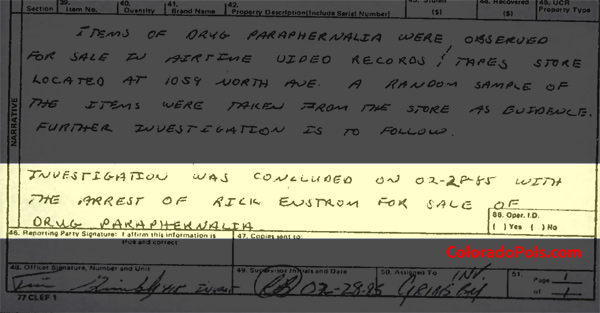
When we last left GOP Colorado House District 23 candidate Rick Enstrom, he was being hit hard by Democratic-aligned groups over an incident from the 1980s where Enstrom was reportedly arrested for selling drug paraphernalia out of a record store he owned. Right after a mailer hit the district detailing this arrest, including a news clip from the Grand Junction Sentinel at the time, Enstrom threatened to sue and insisted that he had never been “arrested.” Unfortunately for Enstrom, the Grand Junction Police Department’s original report clearly states that Enstrom was “arrested for sale of drug paraphernalia.”

Following the exposure of that document, Enstrom changed his tune considerably, admitting “I did what I did,” and primarily quibbling over the semantics of what constitutes an “arrest.” Our own discussions with knowledgeable sources indicate that many incidents properly categorizable as an “arrest” do not make it into the Colorado Bureau of Investigations arrest database, including old misdemeanor incidents like this one. The fact remains that the Grand Junction Police’s original report plainly says what it says, and there’s really nothing to sue about.
But as Lynn Bartels of the Denver paper reported late last week, Enstrom’s not letting this go quietly. A cease-and-desist letter was sent demanding that the Democratic-aligned group in question, the Colorado Accountable Government Alliance, stop this campaign, claiming that “It is indisputable that no determination was ever made that Mr. Enstrom sold illegal drug paraphernalia of any kind, let alone cocaine paraphernalia.” You’ll recall that Enstrom circulated a letter from a former Mesa County District Attorney comparing this situation to a “traffic ticket.”
Enstrom is relying on the fact that the original news reports on his case are very hard to find today–the Grand Junction Sentinel’s online archives, even premium archives like Lexis-Nexis, don’t go back that far. But there is a great deal more to this story that Enstrom doesn’t want you to see–and after you read some of the original news reports, you’ll understand why.

“A traffic ticket,” eh?
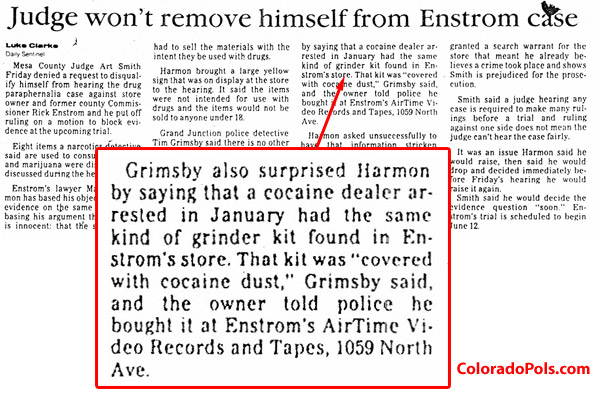
This is a story from the May 25, 1985 edition of the Sentinel on the proceedings in Enstrom’s drug paraphernalia case. Enstrom’s attorney makes it sound as though the details in these mailers and TV spots contain falsely suggest Enstrom was involved in the sale of any drug paraphernalia, “let alone cocaine paraphernalia,” but this published testimony from police about a cocaine dealer in Grand Junction’s use of Enstrom’s product is a major hole in that claim.
Here’s something else you’ll recognize: Enstrom’s response to the charges.

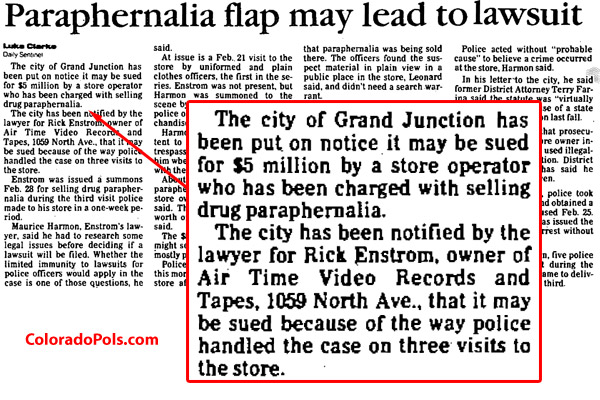
After Enstrom’s citation, his attorneys filed notice of intent to sue the Grand Junction Police Department for their handling of the case. Now, Enstrom settled the case in October of 1985 by signing this settlement with the Mesa County District Attorney’s office:

In which Enstrom acknowledges that the prosecution was “to stop the sale of drug paraphernalia in Mesa County.” He further agrees to not sell drug paraphernalia, acknowledging that doing so is “adverse to the best interests of the community.” Presumably, this also ended Enstrom’s threat of a $5 million lawsuit against the Grand Junction Police Department.
So that’s a brief rundown of the history of Rick Enstrom’s drug paraphernalia case. Based on everything we have reviewed here, and it’s a lot more than we ever wanted to sort through for a state legislative race, Enstrom’s legal threats over these mailers and TV spots are baseless–intended to obfuscate the facts of this embarrassing incident, not clarify them.
And it’s a safe bet that Enstrom’s throwing of legal elbows will stop on Election Day.
Subscribe to our monthly newsletter to stay in the loop with regular updates!
Comments