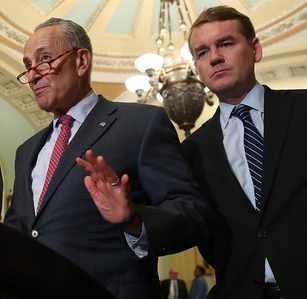
As The Hill reports, Democrats in Washington are beginning to engage in whatever resistance they can without the votes to actually stop the Republican majority with steamrolling ahead on a new Supreme Court Justice six weeks before Election Day 2020:
Senate Democrats are limiting the ability to hold committee hearings in retaliation for Republicans decision to try to fill a Supreme Court seat in the middle of an election year, the first action in what is likely to be an increasingly combative battle over procedure in the Senate.
A Democratic aide confirmed that Senate Minority Leader Charles Schumer (D-N.Y.) had invoked the so-called “two hour rule,” which can be used to limit the ability to hold committee hearings after the Senate has been in session for more than two hours…
“Because the Senate Republicans have no respect for the institution, we won’t have business as usual here in the Senate,” Schumer said from the Senate floor.
A campaign of procedural obstruction to slow down business in the Senate, not unlike the delay tactics waged by Colorado GOP minorities in the General Assembly under Democratic control in 2019, certainly do have the ability to protract and exact the maximum political damage from a majority determined to carry out their agenda. Although Republicans have the votes to push a Supreme Court nominee through to a confirmation vote, even without confirmation hearings, our local Republicans are an example of how well a cohesive minority can jam up the majority–and that’s before we start talking about the moral differences between then and now.
Procedural obstruction may not be the limit of what Democrats can do. Colorado-based liberal commentator David Sirota suggests threatening a full government shutdown, which Speaker Nancy Pelosi has reportedly ruled out, or impeaching William Barr to play havoc with the Senate calendar. But we also know from Colorado experience that while the minority gets their say, it’s the majority who gets their way. And as CNN’s Gregory Krieg and Dan Merica report, it’s the threat of what Democrats have the power to do in the increasingly likely event they win the Senate majority and the White House that might prove the only real bargaining chip:
Sean McElwee, co-founder and executive director of the progressive group Data for Progress, called the threat of eliminating the filibuster, adding justices to the court and new seats in the Senate, the Democratic Senate minority’s “only credible threat.”
“You need a number of Democratic senators to be sending that message to McConnell, because it’s really the only point of leverage that Democrats have,” McElwee said. “Most of the procedural stuff that I’m seeing come out there is a bit of a fantasy, to be entirely frank.”
In the end, Democrats have little to risk from fighting it out over this nomination, and employing every kind of resistance tactic feasible to disrupt Republicans as they barrel with majority power toward the inevitable–along with very explicit promises about how Democrats will remediate the judiciary’s lurch to the right under Donald Trump after victory in November. The specific question of a government shutdown is more complicated because of the ongoing economic and health emergencies of 2020, but everything short of that seems like a no-brainer.
With all of this in mind, however, it’s not pre-emptive concession to acknowledge that this outcome was ensured by Trump’s victory in 2016, and Republican control of the U.S. Senate predating Trump. Unless Senate Majority Leader Mitch McConnell blinks, the only remedy for anything that happens before next January comes at the polls in November.
Subscribe to our monthly newsletter to stay in the loop with regular updates!
Comments